|
The Sailing Life’s for Me!
by Liz Hammond
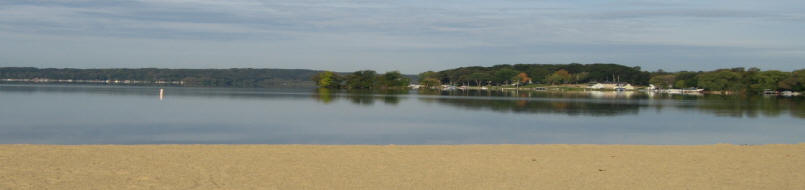
I always wanted to be called “Skipper.” Living by Pewaukee
Lake, every day I would see graceful sailboats gliding over glittering
water on a balmy afternoon as I drove home from work. Sailing
definitely had an appeal to me; but I had no boat – how would I ever do
that?
But, sometimes dreams become reality. I stopped by the
Pewaukee Yacht Club to see if perhaps they had any kind of sailing
classes. Indeed, last year was only the second year the Pewaukee Lake
Sailing School was offering sailing classes for adults -not kids- just
like me. Membership was not required; no boat was required; and you
didn’t even have to have your own life preserver. I, too, could be a
sailor.
With anticipation six of us met – two women and four men –
giddy as schoolchildren, eager to know and experience the secrets of
sailing. We all had different reasons for taking the class: Ron had
gone sailing on his honeymoon and liked it so well, he bought a small
secondhand boat when he returned. Rick wanted to keep up with his kids
who were already expert sailors. Sergej’s motive was, “Why not?” and
because it looked like fun. For Marianne, it was the next thing to try
on her list after a hot air balloon ride.
I didn’t just want to go for a ride in a sailboat– I wanted
to know how to sail one, control it, feel that accomplishment of skill.
With markers and a whiteboard, the young teacher, Joe Bitter, with his
even younger assistants, patiently explained to us the terminology of
sailing and the dynamics of wind and tiller. At first, it was a bit
tricky remembering all of it, especially the part where you pushed the
tiller in the opposite direction from where you wanted to go. One of
the greatest mysteries was how to sail into the wind, upwind, which, to
most logic, makes no sense at all.
After a 45-minute lecture, we were taken out on the lake in
E-boats, a mid-sized sailboat with a main sail, a jib, and a spinnaker,
most often used for racing. We learned firsthand the importance of wind
– or more accurately, the absence of it – and about how a technique
called hiking, whereby you sit on the edge of the boat and lean out as
far as you can to help counterbalance the boat against the wind, can
result in a very wet seat of your pants.
We eagerly took turns working the jib sail, the boards,
rudders located on either side of the center of the boat and the tiller
– with lots of coaching from one of the assistants, who happened to be
only 16 years old.
The second day of classes the wind had picked up creating
whitecaps on the lake. Though sunny, Joe was skeptical about taking us
out on the rough water. When our forlorn faces spoke our
disappointment, Joe asked for volunteers to give it a try – my hand was
the first up, along with Sergej’s. Of course, we were more or less only
passengers on the roller-coaster ride, but what a ride! I grinned the
whole time, reveling in spray in my face and the rhythmic “ca-whump” as
we pounded through the waves – we were moving fast.
I was only vaguely aware of the hard work Joe and his
assistant were doing to keep the boat from capsizing and to control the
speed. Later, the other students said that from the shore it looked
like we went under the waves several times, though we always stayed
afloat. The water calmed a bit for the other students, but I was glad I
had the thrill of the first sail on that wild day.
Each week’s class began with a review of terms and
techniques. Though the arrows and drawings made sense on the
whiteboard, it was something else to remember it at the moments needed
in the sailboat. It seemed the harder I thought and tried to recall
what I was supposed to do when the sails luffed, or went limp in the
wind, the more I drew a blank. It finally dawned on me that the best
way to learn was by doing – by feeling how the wind was blowing, by the
feel of the tiller in my hand, the way the boat felt in my legs and seat
as it moved.
After a while, I quit worrying over terms and techniques,
though I eventually did learn them, and just moved with the boat. I
learned by experiencing how the boat responded to the sails being let
out, or to tacking to turn the boat. I quit being afraid of doing it
wrong and that’s how I finally caught on. Though it sounds corny, you
do sort of “become one with the boat” in order to sail it effectively.
By about the third or fourth lesson, Joe was letting us go
out on our own in small M16 boats with two sails, which required only
two crewmembers, no teacher on board. Of course, he was never far away,
zipping around in a speedboat, bullhorn in hand and giving us
directives. The first evening of our solo sailing, I paired up with
Marianne – we two women were going to show the guys how it was done.
Marianne was a bit nervous at first, but we did great. One of us would
man the tiller and main sail, while the other controlled the jib and
called out wind directions. It was during that first solo sail that I
finally understood what Joe meant by seeing the puffs of wind on
the surface of the water – a sort of dimpling or darkness. It was very
satisfying to recognize it and then make the boat respond the way in
which I wanted. I began to understand, too, the value of teamwork in a
very dynamic setting.
The wind on Pewaukee Lake could change in an instant –
success in a sailboat, neither capsizing nor stalling, requires
anticipation of those changes and a quick response; it helped to have a
reliable crewmate. Later, Joe even had some one-man C- boats for us to
try; of course, one of the guys managed to turn it over, but that’s all
part of the joy of learning to sail. To be competent, one has to know
how to right the boat, too.
By the end of the four weeks of lessons, several were
inquiring about the cost of buying a sailboat and where were the best
deals – we had definitely caught the bug. Knowing how to sail a boat
made it much less risky to consider actually buying one. The costs were
not as high for a used boat as I would have thought. Of course, then
there’s the question of where to store it and needing a trailer and
paying the launch fees – but feeling the breeze in your face, hearing
the quiet “swoosh” of water against your prow, the flap of the sails,
the view of the setting sun on the summer lake – now that’s worth any
price in my book.
Back to the top |